
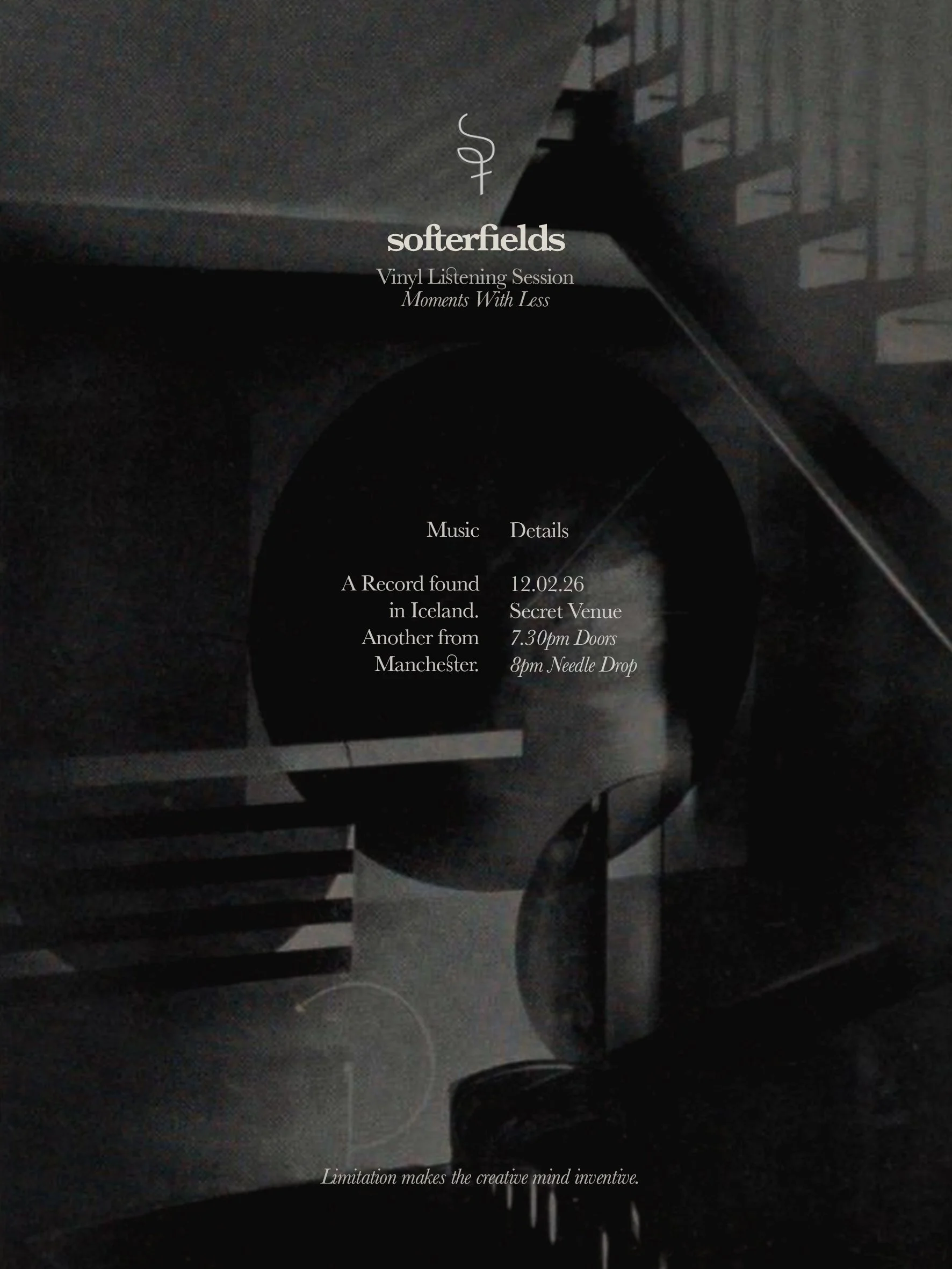
Moments With Less
This session begins with architecture from the 1920s. When Leonard offered his home for today’s listening session, I started thinking about what kind of music would make sense in his space. I could have taken the easy route and chosen something that simply matched the Bauhaus aesthetic as an obvious response.
Today, Bauhaus is often reduced on social media to how it looks. But when you look more closely, it began as a response to necessity. After the First World War, housing shortages and economic instability shaped its thinking. Furniture and everyday objects were designed to be functional, affordable, and easy to reproduce.
Steel tube chairs, modular shelving, and simple lighting were created for factory production. They were simple to assemble and accessible to ordinary people. German design in that era was hardly about status but solving real problems and everyday life.
Aegir’s Mother’s Basement
The opening record comes from a basement in Iceland. When my band motifs was there to record, we became curious about the local music scene and started asking around. In a guitar shop, we met someone named Aegir. He told us that gigs sometimes happened in his mother’s basement and invited us over.
Two days later, about twenty people stood in a low-ceilinged, smoky room while a local doom metal band played. It felt like a real venue. In an area with very few places to play, his mother’s basement had become a cultural landmark.
”This is one of the highlights of my trip. Totally unexpected and surprising. The outside of the house was filled with Christmas decorations and a small path led to the back entrance to a basement filled with smoke machines and people from all walks of life, young and old. We got a few odd stares cos we looked completely out of place, but this basement is where a lot of Icelandic underground bands got their start.” - Leonard Soosay , Snakeweed Studios
Sound In Surroundings
The second part of the evening moves to late 1970s Manchester, through the music of Joy Division and the production of producer Martin Hannett. This was a place shaped by factory closures, rising unemployment, and a sense that the future had narrowed.
Vocals were sometimes sent through telephone lines. Drums were recorded with distant mics. Reverb, room noise, and even silence were kept in the final recordings, allowing the architecture of the building to shape the sound.
End
This session is really about how artists work with what they have. To sit with work shaped by real conditions, and to hear how meaning can emerge quietly, through necessity.
Learn more about Softerfields.
Sessions are currently private. If you’re interested in joining a future session, please DM us on Instagram at @softerfields.